
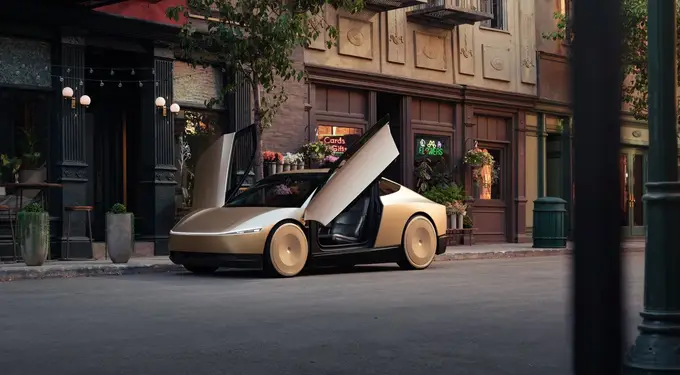
Tesla Inc. has started manufacturing its long-awaited Cybercab robotaxi, Chief Executive Officer Elon Musk said in a post on social media platform X.
The announcement marks a key milestone in the company’s push into autonomous ride-hailing, even as its global vehicle sales continue to face pressure.
Musk indicated that production ramp-up for the Cybercab has begun this month, fulfilling a timeline that the company had previously outlined to investors.
The development comes at a time when Tesla’s broader business has been grappling with declining demand across key markets.
Cybercab positioned at centre of robotaxi strategy
Tesla envisions the Cybercab as a central component of its future robotaxi network.
The system is expected to operate as a mixed fleet, comprising vehicles both with and without human safety monitors.
The Cybercab, a two-door, two-seat electric vehicle, was first unveiled two years ago.
It drew significant attention for its unconventional design, notably lacking a steering wheel or pedals.
Such a configuration would require regulatory exemptions in the United States before it can be deployed at scale.
Musk has previously stated that the Cybercab will be more affordable than other Tesla models.
However, the company has not yet disclosed pricing details, leaving uncertainty around its positioning in the broader electric vehicle market.
Q1 results highlight pressure and rising investments
Tesla’s first-quarter 2026 results reflected a mix of financial performance and long-term ambition.
The company reported revenue of $22.39 billion, while net income attributable to common shareholders stood at $477 million.
Adjusted earnings per share came in at 41 cents, and free cash flow reached $1.44 billion.
Vehicle deliveries totalled 358,023 units during the quarter, indicating continued pressure on demand.
At the same time, Tesla increased its spending significantly.
Capital expenditure rose to $2.49 billion in the quarter, signalling a more aggressive investment cycle.
Stock movement remains muted despite production update
Tesla shares showed limited reaction to the announcement.
The stock rose less than 1% in premarket trading before the start of regular market hours.
Despite the marginal uptick, the stock remains under pressure, having declined 17% so far this year.
The muted market response reflects ongoing investor concerns about Tesla’s near-term growth outlook and the pace at which its autonomous vehicle ambitions can translate into meaningful revenue.
Expansion plans across major US cities
Tesla’s ride-hailing business is set for further expansion across the United States.
The company told investors during a recent earnings call that it plans to extend its robotaxi operations to Phoenix, Miami, Orlando, Tampa, and Las Vegas in the first half of the year.
The company initially launched its robotaxi services in Austin last year.
Since then, it has gradually expanded operations, including the introduction of services in Dallas and Houston earlier this month.
Revenue impact expected to take time
Despite the progress in production and geographic expansion, Tesla has cautioned that the financial contribution from its robotaxi business will take time to materialise.
As cited in Bloomberg report, Musk said the company is unlikely to generate material revenue from the segment until at least 2027.
The company has not provided detailed information regarding fleet sizes or the number of vehicles operating without safety monitors.
This lack of clarity, underscores the gradual nature of Tesla’s rollout strategy.
While the Cybercab production marks a significant step forward in Tesla’s autonomous ambitions, the slow ramp-up and delayed revenue expectations suggest that the initiative remains a long-term bet rather than an immediate growth driver.
The post Elon Musk says Tesla has started producing cybecabs appeared first on Invezz