
The United States is two months into its most consequential military operation since Iraq.
Oil prices have surged more than 55%, and the IMF has cut its global growth forecast.
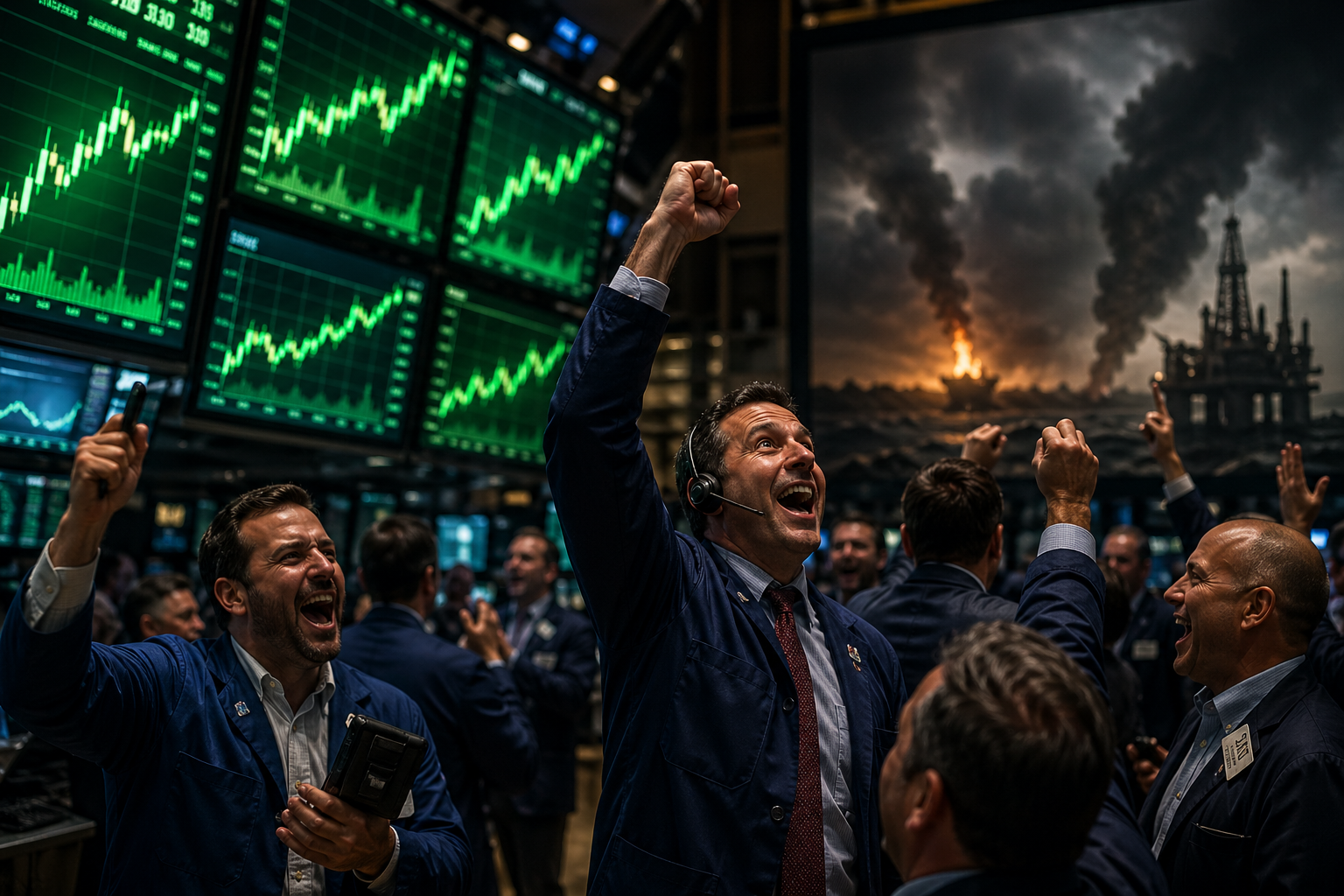
At the same time, the S&P 500 just closed above 7,000 for the first time in history. US market indices are surging.
This contradiction explains what is happening in the world, and what is happening on Wall Street may be the most important financial story of 2026.
The scale of the supply shock
Almost 2 months into the war, Supreme Leaders have been eliminated, allies have fallen out, the Strait of Hormuz has been closed, and energy shocks are threatening economies around the world.
Brent crude jumped from $72 a barrel before the war to nearly $120 at its peak, a surge of more than 65%. Gas prices at the pump rose 37% nationally to $4.10 a gallon.
The IMF responded by cutting its 2026 global growth forecast to 3.1% and raising its inflation outlook to 4.4%.
Treasury yields climbed 50 basis points to 4.4% as the Fed’s rate-cut path clouded over considerably.
The S&P 500 fell 8% from the start of the war to its March 30 low. Five consecutive weekly declines, a streak that has only happened twice in fifteen years.
For a moment, the market appeared to be treating the conflict with the seriousness the macro data suggested it deserved.
From nadir to all-time high in three weeks
By April 15, the S&P 500 had crossed 7,000 for the first time ever. The Nasdaq had rallied more than 18% from its March lows.
The rebound from trough to all-time high was faster than the COVID recovery in 2020 and faster than the tariff-shock bounce in April 2025. The war was still active.
The Strait remained effectively closed. Iran’s leadership was fractured and unresponsive at the negotiating table.
The initial catalyst was a two-week ceasefire announced on April 7, which triggered massive short-covering after hedge funds had spent weeks building bearish positions.
That mechanical dynamic gave the rally its early fuel.
What sustained it was a combination of forces largely disconnected from the geopolitical situation.
86% of S&P 500 companies reporting earnings beat analyst expectations, AI and semiconductor stocks resumed their structural uptrend, and investors leaned into what traders have started calling the “TACO” trade, shorthand for “Trump Always Chickens Out,” buying every dip on the assumption that Trump would de-escalate before economic pain became politically unmanageable.
As of Monday morning, Iran sent Washington a new proposal through Pakistani mediators. Iran is willing to reopen the Strait of Hormuz, extend the ceasefire toward a permanent end to the war, and defer nuclear negotiations to a later stage.
And just like that, markets continue their rally into pre-market trading.
Why the headline index number can mislead
Technology stocks represent nearly half the S&P 500 by market capitalisation and are running on an entirely separate fundamental story, one built around AI infrastructure spending, cloud revenue and semiconductor demand that is largely immune to oil prices.
Strip out the Magnificent Seven and their AI-adjacent peers, and the rest of the index has had a considerably more difficult two months.
Europe and Asia, far more dependent on Middle Eastern energy imports, saw the MSCI ex-US index fall more than 10% in March alone.
American consumers are paying $4.10 a gallon at the pump.
What looks like broad market resilience is, in large part, a handful of mega-cap technology companies pulling the index to records while energy-sensitive sectors absorb real damage beneath the surface.
Diminishing returns on peace headlines
The behavioural pattern worth watching closely is not the rallies themselves but their shrinking magnitude.
Each time there is a new deal announced, the market rallies, but the positive responses to each new announcement diminish, and investors are becoming fatigued.
Markets have been conditioned by fifteen years in which every major crisis, from the European debt shock to COVID to last year’s tariff volatility, was eventually resolved through policy intervention.
Buying dips has been the most consistently profitable strategy of the modern investing era, and that track record shapes how risk gets processed today, often before the underlying facts have resolved.
The sequencing problem in Iran’s new proposal
Iran’s latest offer contains a structural detail that markets appear to be pricing past.
Trump’s two stated war objectives were to strip Iran of its enriched uranium stockpile and suspend enrichment for at least a decade.
The Iranian proposal sequences the deal so that the Strait reopens and the blockade lifts first, with nuclear talks beginning only afterwards.
That sequencing would return to Iran its primary source of negotiating leverage before Washington has secured a single nuclear concession.
The White House has received the proposal but did not indicate willingness to explore it on those terms.
That leaves markets facing a narrower set of realistic near-term outcomes than current prices reflect. The war continues with oil staying well above $100 and Q2 earnings guidance written against an energy shock rather than pre-war assumptions.
Talks collapse again, and the Strait remains closed into the second half of the year. Or a deal gets done on terms that fall well short of Trump’s original nuclear objectives.
The S&P 500 at 7,000 is pricing a clean resolution. The diplomatic picture this week is not that.
Ultimately, this is a market that has been so thoroughly trained by repeated policy interventions — quantitative easing, tariff reversals, Fed pivots, ceasefire announcements — that it has lost the ability to sit with genuine uncertainty.
It defaults to optimism because optimism has been rewarded every single time for nearly a decade and a half.
The muscle memory of buying dips has overridden the analytical instinct to ask what if this time it doesn’t resolve?
The post Has Wall St been bailed out so many times it can no longer price a crisis? appeared first on Invezz