

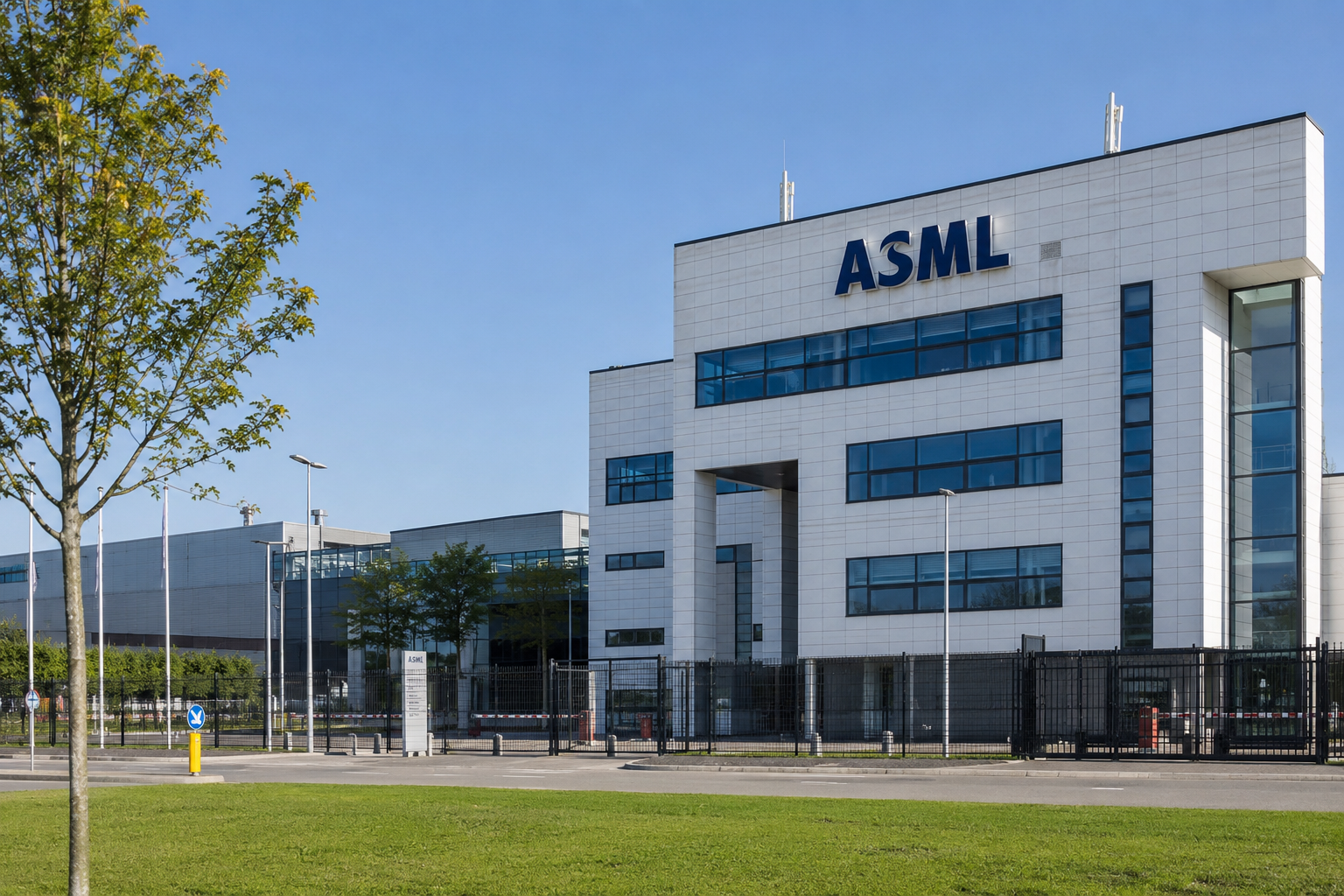
ASML shares continued to decline in premarket trading on Tuesday after suffering heavy losses in the previous session, as investor concerns over China’s progress in semiconductor equipment manufacturing weighed on sentiment.
The Dutch chip equipment maker was down 4% before the opening bell after closing nearly 6% lower on Monday, following a report that China has begun manufacturing domestically developed immersion deep ultraviolet (DUV) lithography machines.
The Information reported that China has started producing its own immersion DUV lithography systems, equipment long dominated by ASML.
While China has been barred from purchasing ASML’s most advanced extreme ultraviolet (EUV) lithography machines under export restrictions, Chinese chipmakers have increasingly relied on the company’s older immersion DUV systems to manufacture advanced semiconductors.
If domestic alternatives prove commercially viable, investors fear ASML’s remaining opportunities in the Chinese market could gradually diminish.
The continued weakness suggested the broader semiconductor selloff could extend into another trading session, with ASML now down about 12% over the past month.
Bank of America sees buying opportunity
Despite the selloff, Bank of America argued that the recent weakness has created one of the semiconductor sector’s most attractive buying opportunities in years.
Analysts led by Didier Scemama said the Philadelphia Semiconductor Index has underperformed the S&P 500 by 18%, pushing valuations well below historical averages.
“Given strong fundamentals, we think the sector looks highly attractive trading on a 3x discount to average ’28 CSS multiples and semicaps specifically at a 6-7x discount,” Scemama wrote.
“We see enhanced buying opportunities for Semicaps where visibility is the highest.”
The bank believes the recent decline has been driven primarily by trade-related concerns rather than any deterioration in industry fundamentals.
AI spending continues to support outlook
Bank of America expects wafer fabrication equipment spending to reach at least $250 billion by 2028, implying two consecutive years of roughly 30% annual growth.
The projection is supported by long-term supply agreements across AI-related chip manufacturing, including a reported five-year, $200 billion foundry agreement between Samsung and Broadcom, as well as recently announced increases in capital expenditure by TSMC and Intel.
The bank also dismissed concerns that memory prices could collapse despite growing production capacity.
“Fears of memory pricing crash seem unfounded in our view given LTAs signed by all major hyperscalers, automotive and consumer OEMs,” the analysts wrote.
ASML remains BofA’s preferred European chip equipment stock
Bank of America continues to rate ASML as a Buy, arguing that the company’s strong pricing power and structurally higher gross margins remain intact despite the latest concerns over China.
The brokerage’s earnings estimates for calendar years 2027 and 2028 are 6% to 7% above current Wall Street consensus.
Among other European semiconductor equipment makers, BofA expects ASM International to outperform market expectations when it reports quarterly results after European trading closes on Tuesday.
The bank cited higher capital expenditure from TSMC and Intel, continued strength in China and an improving outlook for analogue and power semiconductors as key drivers.
STMicroelectronics also remains Buy-rated despite recent investor disappointment over slower margin expansion.
“While the market has been clearly disappointed by STM’s more gradual margin leverage, we think that its earnings power of $4.50+ in CY28E remains intact,” Bank of America said, pointing to improving manufacturing efficiency, a strong order pipeline and growth opportunities in optical components and low-Earth-orbit satellite technologies.
The post ASML stock slips again: why BofA remains strongly bullish appeared first on Invezz