

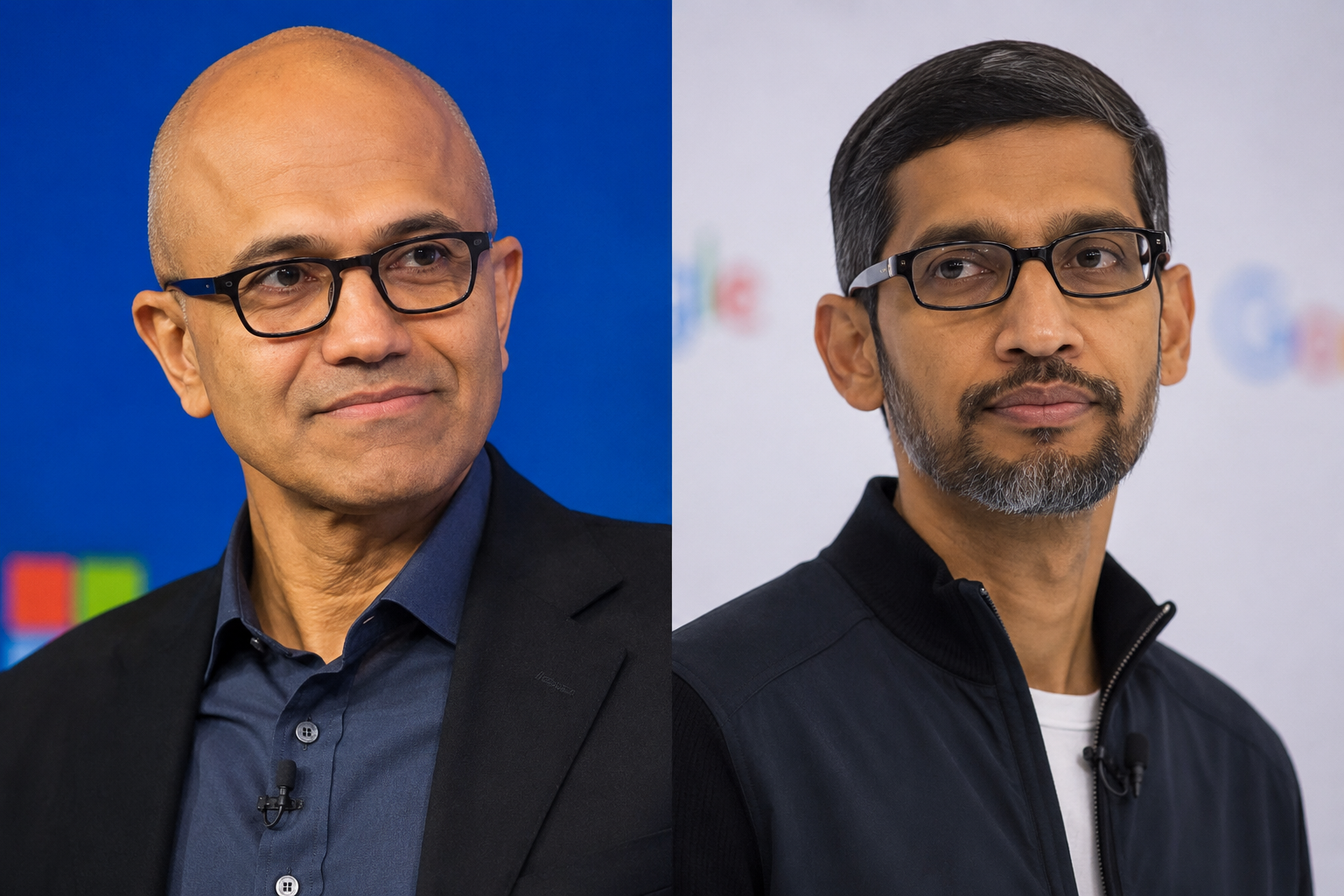
Both Alphabet and Microsoft reported strong earnings driven by robust cloud growth in their latest quarterly results, but investors reacted very differently.
While Alphabet shares had fallen 7% after the company’s earnings release, Microsoft stock surged about 9% in premarket trading on Thursday.
The divergence had little to do with cloud performance alone.
Instead, as has been the observed trend in recent times, investors focused on the companies’ capital expenditure plans, free cash flow generation and whether massive investments in artificial intelligence are beginning to produce meaningful financial returns.
Alphabet’s cloud revenue had risen 82% year over year to $24.8 billion during the quarter ended June, comfortably exceeding analysts’ expectations of roughly 64% growth, according to LSEG data.
However, the strong operational performance was overshadowed by another significant increase in spending plans.
Chief Financial Officer Anat Ashkenazi told analysts that Alphabet now expects capital expenditures of between $195 billion and $205 billion during 2026, compared with previous guidance of $180 billion to $190 billion.
The revised forecast also exceeded analysts’ expectations of about $188 billion, according to Visible Alpha.
The higher spending guidance reinforced investor concerns that AI infrastructure costs continue to rise faster than previously anticipated.
How Microsoft’s capex numbers calmed investor jitters
Microsoft entered earnings season facing many of the same questions as Alphabet.
Investors were closely watching whether the software giant would raise capital expenditure guidance again amid growing concerns that AI infrastructure spending is becoming increasingly difficult to justify.
Instead, Microsoft largely reassured the market.
Azure revenue increased 43% during the fiscal fourth quarter, beating analyst expectations of about 40%, according to Visible Alpha.
The cloud platform generated $39.3 billion in revenue during the quarter.
Chief Executive Officer Satya Nadella also disclosed that Azure annual revenue had surpassed $100 billion for the first time.
“Azure revenue surpassed $100 billion for the first time, and Microsoft 365 Copilot reached over 30 million paid seats, reflecting the confidence customers are placing in us to power their AI transformation,” Nadella said.
The results suggested Microsoft’s AI products are continuing to attract paying enterprise customers while strengthening demand for its cloud infrastructure.
More crucially, unlike Alphabet, Microsoft did not increase its AI spending outlook.
The company maintained its investment plans, forecasting first-quarter fiscal 2027 capital expenditures of $50 billion, below analyst estimates of $56 billion.
It also projected calendar-year 2026 capital expenditures of $175 billion, below its own earlier estimate of $190 billion.
Although Microsoft spent $41 billion during the April-June quarter, up more than 70% from a year earlier, the market appeared relieved that management was not signaling another acceleration in spending.
Impact on free cash flow compared
Microsoft’s free cash flow also provided reassurance.
Microsoft generated $19.6 billion in free cash flow during the fiscal fourth quarter, exceeding analyst expectations of $13.4 billion, according to Visible Alpha, even though it declined 23% from a year earlier.
Management further strengthened confidence by stating that the company expects to remain free cash flow positive during fiscal 2027.
That contrasted with Scotiabank’s forecast issued a day earlier, which had predicted Microsoft could slip into negative free cash flow next year while lowering its price target.
This contrasted with Alphabet’s FCF figures.
The company reported negative free cash flow of $5.9 billion during the quarter, compared with nearly $5.3 billiongenerated during the same period last year.
Ashkenazi acknowledged that free cash flow is likely to remain under pressure as Alphabet continues expanding AI infrastructure.
Bloomberg Intelligence analyst Mandeep Singh said the company’s operating performance remained strong, but questioned whether investors would remain comfortable if spending continues rising.
“Right now they are probably $10-$15 billion free cash flow for this year, next year if this goes to $300 billion there is no way they’re going to be positive free cash flow,” Singh said during a Bloomberg podcast.
Accounting change also lowers reported capex
Microsoft also disclosed an accounting change that helped reduce reported annual capital expenditure.
The company said it will now amortize long-term data centre leases over 25 years instead of 15 years.
Extending the amortization period reduces the annual expense recognized in financial statements, even though the overall lease commitment and cash obligations remain unchanged.
While the change does not reduce Microsoft’s actual investment, it lowers reported capital expenditure and improves certain financial metrics followed closely by investors.
AI investments appear to be paying off for Microsoft
For investors, Microsoft’s quarter offered evidence that its enormous AI investments are beginning to generate tangible financial returns.
Cloud growth accelerated, Azure crossed the $100 billion annual revenue milestone, and Microsoft 365 Copilot reached more than 30 million paid seats, up from 20 million in the previous quarter.
Analysts had expected about 26.9 million paid seats, according to Reuters calculations based on estimates from Citi, Morgan Stanley, BNP Paribas and Wells Fargo.
Microsoft also reported a cloud contracted backlog of $678 billion, compared with $627 billion in the previous quarter.
The company said the entire sequential increase of roughly $50 billion came from customers outside the leading US AI model developers, indicating broad enterprise adoption rather than reliance on a handful of hyperscale AI companies.
“The company is still spending heavily on chips, data centres and networking equipment. Capital expenditure means money used to build assets that support the business for years. Yet investors could connect that spending to faster cloud growth and more paying Copilot users. The bill is large, but the restaurant appears busy,” wrote Ruben Dalfovo, Investment Strategist at Saxo.
Analysts remain optimistic despite future spending
Barclays analysts said Microsoft’s latest results provide enough evidence for investors to reconsider the stock following its nearly 19% decline this year.
“The company is delivering better Azure and finally better Office growth, while also not surprising negatively on its capex outlook and FCF targets,” the analysts wrote.
“Given the different set-up for other main players (larger AI investments), we see a positive reaction.”
Even so, Microsoft’s future commitments remain substantial.
In a securities filing, the company disclosed that it has $329.1 billion worth of data center leases that have yet to commence, with lease terms scheduled to begin between fiscal 2027 and fiscal 2033.
Microsoft noted that some of these agreements remain subject to contractual conditions before becoming effective, indicating that a significant portion of its planned infrastructure expansion is still in the pipeline.
The post Why MSFT soared but GOOG sank despite strong earnings and cloud growth appeared first on Invezz