

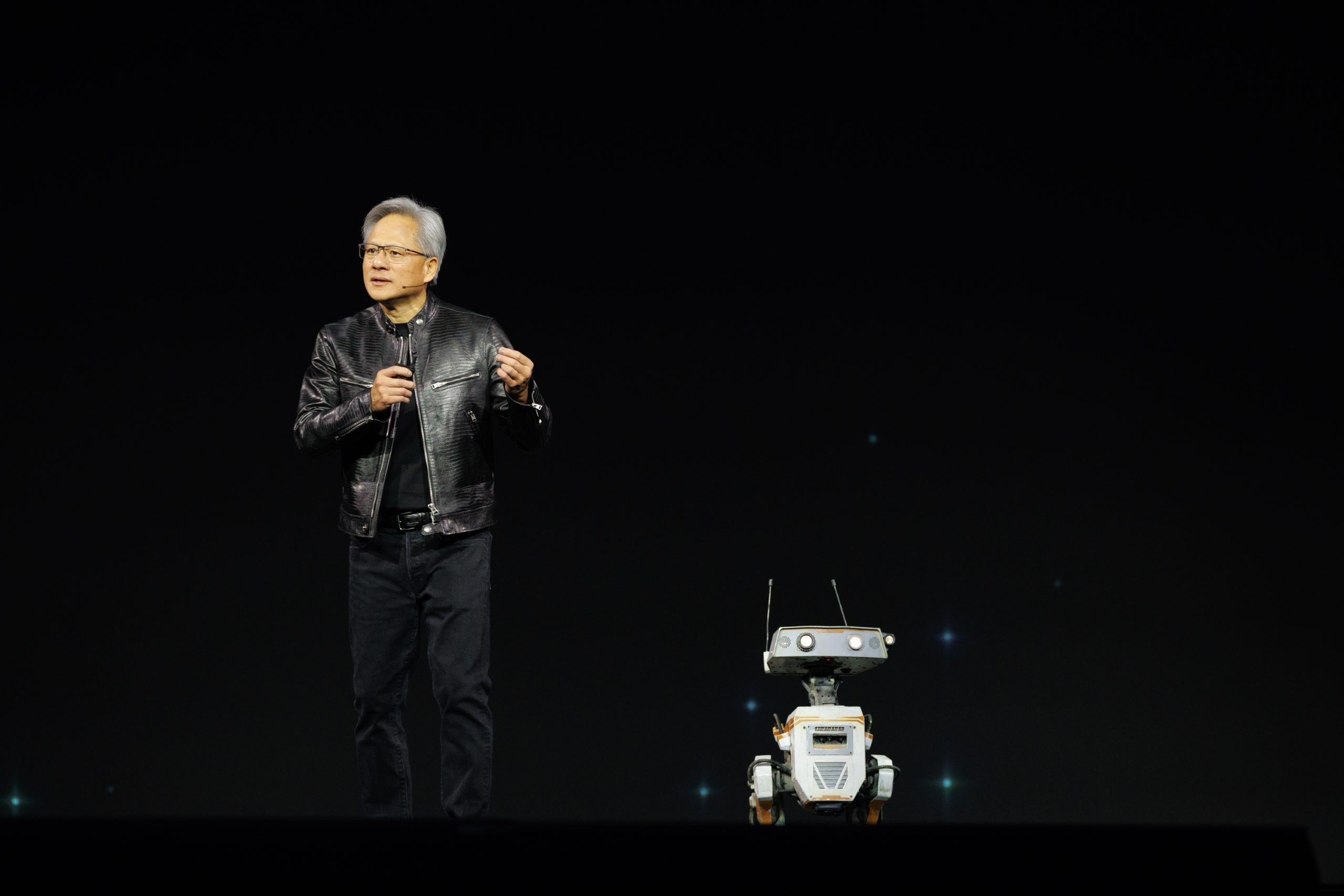
Nvidia is turning to Wall Street to keep the AI spending boom moving, expanding from selling chips to helping customers finance the infrastructure that uses them.
The company announced partnerships with Apollo, BlackRock, Blackstone, Brookfield, Goldman Sachs and KKR to mobilise more than $500 billion of third-party capital for AI infrastructure over time.
The memorandums of understanding still require final agreements, so this is not a committed $500 billion fund.
Nvidia stock (NASDAQ: NVDA) fell 2.9% to $217.55 on Monday as the announcement revived concerns about the chipmaker’s growing ties with AI customers and financiers.
Wall Street becomes another engine for Nvidia demand
The idea is straightforward. AI developers, cloud providers, enterprises and governments need enormous amounts of computing capacity, but building data centres requires billions of dollars upfront.
Nvidia wants institutional investors to finance that infrastructure, turning AI compute into an asset class for long-term private capital.
Easier financing could support more data-centre construction, more Nvidia systems and wider adoption of its CUDA software ecosystem.
Jensen Huang called it “a new class of productive, investable infrastructure”, arguing Nvidia compute can generate revenue across customers and workloads for years.
Goldman Sachs chief executive David Solomon backed the logic, saying Nvidia creates an opportunity for a market in credit backed by its computing infrastructure.
Investors remain nervous about whether enormous AI capital expenditure will earn sufficient returns.
JPMorgan analysts told The Wall Street Journal that those concerns could ease as monetisation improves, with backlog and demand increasingly keeping pace with spending.
The clever financing plan revives an uncomfortable question
The problem is that Nvidia is already deeply involved across the ecosystem, buying its products.
It invests in AI companies, cloud providers and infrastructure businesses that can use the capital to expand Nvidia-powered capacity.
That has fuelled fears of circular financing, where financial support helps create demand for the supplier providing it.
Bernstein analyst Stacy Rasgon has previously raised that concern, but remained bullish after Nvidia’s recent dealmaking.
Business Insider reported in late July that Rasgon reiterated a Buy rating and $315 target despite the increasingly interconnected financing structure.
There is an important counterargument. Nvidia generated about $157 billion in free cash flow across fiscal 2025 and 2026, followed by another $48.6 billion in its latest reported quarter.
That gives it far more flexibility than a weak vendor lending simply to keep customers buying.
Real danger starts if AI economics disappoint
The $500 billion plan is not traditional vendor financing. Apollo, BlackRock and other partners are expected to independently underwrite investments with third-party capital rather than depend primarily on Nvidia’s balance sheet.
That reduces Nvidia’s direct exposure, but does not eliminate it. Nvidia may provide residual-value support of up to 25% on some projects, leaving it exposed if infrastructure values or utilisation fall.
If AI customers generate strong returns, the model becomes a flywheel: investors provide capital, customers build capacity, Nvidia sells systems and financiers earn infrastructure-style returns.
If monetisation disappoints, the same links become a vulnerability. Weaker customers could reduce chip orders just as asset values fall and financing conditions tighten.
Wall Street remains overwhelmingly bullish. As per market data, 78 of 81 analysts tracked by Bloomberg rated Nvidia a Buy.
The post Nvidia stock has a $500 billion trick to keep AI spending alive: will it work? appeared first on Invezz