
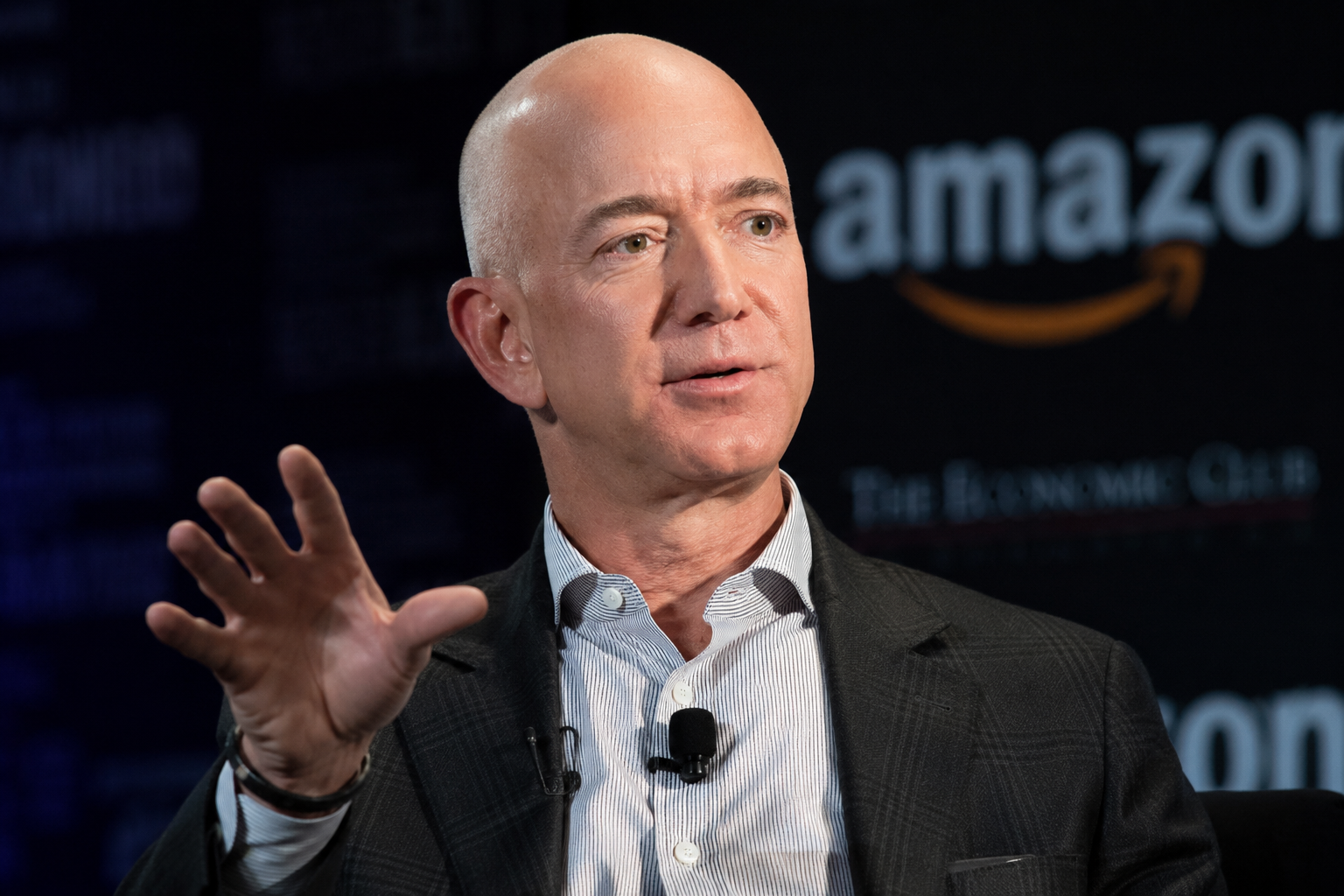
Amazon stock (NASDAQ: AMZN) slipped overnight after the company entered the $3 trillion club, turning attention towards founder Jeff Bezos and a share-sale plan now worth billions.
The stock closed 4.6% higher at a record $284.02 on Monday, pushing Amazon’s market value above $3 trillion.
The rally followed a second-quarter report in which Amazon Web Services revenue grew 37%, its fastest pace in 18 quarters.
Bezos is monetising a historic valuation
As per Amazon’s annual filing with the US Securities and Exchange Commission, Jeff Bezos can sell up to 15 million Amazon shares.
At Monday’s closing price, the full 15-million-share allocation would be worth about $4.3 billion. That is a major personal transaction, but it represents only around 0.14% of Amazon’s market value.
The optics are nevertheless striking. Amazon’s founder is positioned to convert shares into cash after the company reached a record valuation and Wall Street grew more confident that its artificial-intelligence investments are producing measurable demand.
The sale should not be read as a sudden bearish call. Amazon’s annual filing shows Bezos adopted the Rule 10b5-1 plan on November 14, 2025. It permits sales through February 26, 2027, subject to conditions.
That structure allows transactions to occur over an extended period and reduces the significance of any single sale date.
It also means Bezos did not decide to unload 15 million shares after Amazon crossed $3 trillion.
The plan looks well timed, but disciplined diversification at a strong valuation is different from declaring that Amazon has peaked.
AWS delivered the growth Wall Street wanted
Amazon reached the milestone because investors received clearer evidence that cloud and AI expenditure is translating into revenue.
AWS sales climbed 37% to $42.2 billion, accelerating from 28% growth in the first quarter and beating expectations for roughly 31% expansion. Operating income rose to $16.6 billion from $10.2 billion a year earlier.
Bernstein analyst Mark Shmulik said AWS had “finally” reached its long-awaited growth inflection.
Evercore ISI analyst Mark Mahaney described the quarter as a decisive revenue beat with Amazon moving through its capital-expenditure digestion phase faster and more profitably than feared.
Morningstar analyst Dan Romanoff told Barron’s that 37% growth was remarkable given AWS’s scale.
He said demand across conventional cloud and AI workloads supported management’s investment plans.
Those comments suggest Bezos would be selling into improving fundamentals, rather than a rally driven solely by market enthusiasm.
Cash burn is the more important warning
Amazon increased expected 2026 capital expenditure to $220 billion from $200 billion as it builds data centres, purchases chips and expands AI infrastructure.
Trailing 12-month free cash flow meanwhile fell to a $7.6 billion outflow, compared with positive cash generation a year earlier.
Zacks Investment Research strategist Ethan Feller told MarketWatch that the negative position was intentional but still “warrants monitoring” while spending remains elevated.
Amazon’s reported $62.6 billion quarterly net income also included $53.4 billion of pre-tax non-operating income, primarily linked to the rising value of its Anthropic investment, rather than ordinary business operations.
That makes cash generation the real test of the $3 trillion valuation.
AWS must sustain rapid growth, protect margins and ultimately produce enough cash to fund infrastructure while rewarding shareholders.
The post Amazon stock dips after $3 trillion: is Jeff Bezos selling at the perfect moment? appeared first on Invezz