

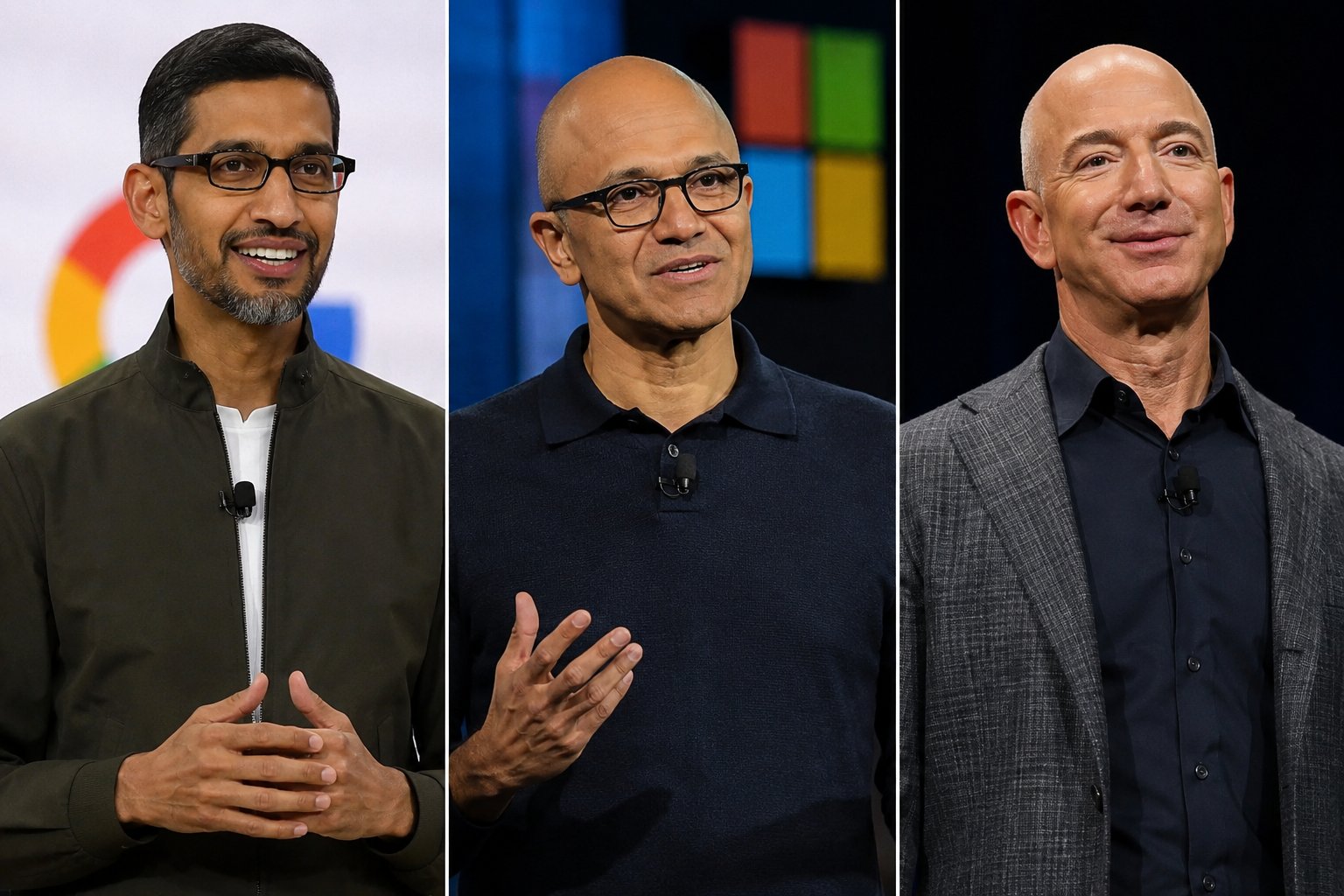
When Alphabet (GOOGL) released its earnings last week, a rapid growth in its Google Cloud business revenue was seen as a pressure point on Microsoft and Amazon, which were to announce their earnings this week.
For much of the past two years, investors debated whether Google Cloud could meaningfully challenge Microsoft Azure and Amazon Web Services as artificial intelligence reshaped enterprise technology spending.
Instead of exposing a clear winner, the latest earnings season showed that each of the three hyperscalers is strengthening its position in different ways.
Google Cloud is growing the fastest, Microsoft continues to demonstrate remarkable resilience despite intense competition, while Amazon Web Services remains the industry’s profit engine with its strongest expansion in more than four years.
Growth figures aside, the cloud results from all three companies answered a larger question: that massive AI investments are generating enough demand to justify the spending.
Google Cloud’s growth was the strongest
Alphabet fired the opening shot last week with one of the strongest cloud quarters in its history.
Google Cloud revenue surged 82% year over year to $24.8 billion during the quarter ended June, far ahead of analysts’ expectations of roughly 64% growth, according to LSEG.
The performance strengthened the narrative that Google Cloud has been expanding faster than both Microsoft Azure and AWS in recent quarters, raising hopes that it was steadily gaining market share.
Demand has become so strong that Alphabet executives said they would rent additional data-centre capacity from third parties to serve customers, even though doing so is expected to weigh on margins.
Wall Street responded by lifting expectations for the company.
More than 20 brokerages raised their price targets following the results, with the median target climbing to $430, nearly 26% above the stock’s last close.
Citizens issued the highest target at $515, while TD Cowen remained the most cautious at $240.
“Google Cloud was an absolute blow out,” said Richard Clode, Portfolio Manager of Janus Henderson Investors’ Global Technology Leaders, in comments reported by Reuters.
“Alphabet has competitive advantage running all the way through the stack from their own custom AI chips through to distribution to billions of users.”
Yet the market’s initial reaction was surprisingly muted.
Despite delivering one of the strongest cloud growth numbers among the major hyperscalers, Alphabet shares fell after earnings as investors focused instead on sharply higher capital expenditure guidance and the company’s first negative quarterly free cash flow in years.
The response illustrated that investors are becoming increasingly selective about AI spending, rewarding companies only when rapid revenue growth is matched by evidence that investment remains financially sustainable.
Microsoft proves Azure is still firmly in the race
If Google’s results raised questions about Microsoft’s competitive position, Azure’s earnings provided an emphatic response.
Microsoft reported that Azure revenue rose 43% in its fiscal fourth quarter, comfortably ahead of analysts’ consensus estimate of about 40%, according to Visible Alpha.
Its Intelligent Cloud segment generated $39.31 billion in revenue, representing annual growth of 31.6% and exceeding StreetAccount estimates of $38.16 billion.
Azure’s growth also accelerated from 40% in the previous quarter to 43%, while annual Azure revenue crossed the $100 billion milestone for the first time.
The results immediately shifted market sentiment.
“It seemed kind of like Google was taking market share from everybody, and they could catch up to the market share of Azure if they keep on that trajectory,” Dave Wagner, portfolio manager at Aptus Capital Advisors, told Reuters.
“But what Azure is showing us is that it’s staying right there in the race.”
Microsoft’s earnings also addressed another issue weighing on technology stocks in recent weeks—whether the industry’s massive AI investments were becoming too expensive.
Unlike Alphabet, Microsoft reassured investors by keeping its long-term capital expenditure outlook broadly unchanged while reiterating that it expected to remain free cash flow positive during fiscal 2027.
Azure’s accelerating growth, coupled with disciplined spending guidance, convinced investors that Microsoft’s AI investments were already translating into commercially meaningful demand.
The stock responded accordingly, surging about 15% after the results, while semiconductor companies and AI infrastructure suppliers rallied alongside it.
Amazon reminds investors why AWS remains the leader
Amazon became the final piece of the puzzle.
Amazon Web Services reported revenue growth of 37% to $42.2 billion during the second quarter ended June 30, comfortably beating analysts’ expectations for growth of just over 31%, according to LSEG.
It was also the fastest growth printed in 18 quarters, which Morningstar described as “astounding” given AWS’s enormous scale.
“AWS is booming,” chief executive Andy Jassy said in a statement.
“Our AI and chips businesses each eclipsed run rates of more than $25 billion.”
Jassy added during the earnings call: “AWS is now a $169 billion dollar annualized revenue run rate business, which, for perspective, would place it 24th on the Fortune 500 list if it was a standalone company.”
AWS contract backlog increased to $496 billion from $364 billion in the previous quarter, while Jassy acknowledged that demand remains so strong that the company still lacks enough computing capacity despite significantly increasing capital expenditure.
The strong performance prompted at least five brokerages to raise their price targets.
“We’re encouraged by the strength in the core AWS business, which has a high correlation with AI revenue, and we expect this relationship to further strengthen over time as more AI workloads move into full-scale production and drive additional demand for core services,” JP Morgan wrote in a note.
“There were concerns about market share losses on AWS, but that’s been put to bed now,” Dan Morgan, portfolio manager at Synovus Trust, said.
“It just gives more evidence that AWS’s lead is still intact. The AI tide is rising all boats here.”
Why Google Cloud’s growth deserves a deeper look
Cloud Wars founder Bob Evans, who closely tracks the cloud and AI industries through research, interviews, and market analysis, argued that customers are increasingly differentiating between the three hyperscalers rather than treating them as interchangeable providers.
“The numbers show that customers don’t view the hyperscalers as some homogenous blob where there’s not even a dime’s worth of difference among the companies. Quite the contrary,” Evans wrote.
He pointed out that while all three companies have accelerated cloud growth in recent quarters, Google Cloud’s expansion continues to outpace its rivals by a considerable margin.
“The numbers also show a powerful quantitative shift among customers for the AI and cloud solutions that Google Cloud is offering, because Google Cloud added an astonishing $4.8 billion in incremental Q2-over-Q1 revenue, by far the biggest sequential quarter-to-quarter jump ever reported by any hyperscaler,” he said in a note.
According to Evans, that reflects a meaningful shift in customer preference.
“It shows that right here in the present — not two or three or four years in the past — more and more customers are choosing Google Cloud as their preferred provider.”
Google Cloud’s backlog and what it says
The latest earnings season also shifted investor attention away from quarterly revenue growth and towards a metric that could determine who dominates enterprise AI over the next several years: backlog.
For cloud providers, backlog, or remaining performance obligations (RPO), represents contracted business that will be recognised as revenue in the future.
As companies commit billions of dollars to AI infrastructure, these figures provide one of the clearest indicators of long-term demand.
That is where the competitive picture becomes more nuanced.
Google Cloud’s backlog also reflected that momentum.
Its backlog jumped 390% year over year to $514 billion, beating analyst estimates of $488.1 billion.
Alphabet added more than $50 billion of new backlog sequentially during the quarter, the largest increase among the three companies.
Alphabet expects just over half of that backlog to convert into revenue over the next two years, with the remainder recognised over longer periods.
Despite the impressive numbers, Alphabet’s backlog is not without risk.
Much of the increase reflects large, multi-year AI compute contracts that can carry significant headline values.
Those agreements could become vulnerable if customers decide to renegotiate spending or reduce future compute requirements as competing infrastructure becomes cheaper or more readily available.
That risk has become more visible as Chinese AI models continue improving rapidly and domestic semiconductor manufacturing capabilities advance.
For now, however, investors appear willing to accept that uncertainty, given the pace at which Google Cloud continues to add customers.
Microsoft’s backlog masks a concentration risk
Microsoft reported the largest commercial remaining performance obligations among the three companies.
Commercial RPO rose 84% year over year to $678 billion.
On the surface, that appeared to reinforce Microsoft’s leadership in enterprise AI.
However, one comment from chief financial officer Amy Hood during the earnings call suggested that a substantial portion of that backlog may be tied to a single customer: OpenAI.
Rather than disclosing OpenAI’s commitments directly, Hood said commercial RPO “increased 25% when excluding OpenAI.”
Microsoft ended fiscal 2025 with a commercial RPO of $368 billion.
According to Benzinga, if backlog excluding OpenAI grew 25%, Microsoft’s commercial RPO without its AI partner would now stand at roughly $460 billion.
That implies approximately $218 billion of Microsoft’s reported $678 billion backlog could be associated with OpenAI-related commitments, representing roughly one-third of the total.
Microsoft also emphasised that all sequential commercial RPO growth this quarter came from customers outside frontier AI model companies, suggesting management is actively trying to diversify its order book beyond its largest AI partner.
That effort is encouraging, but the company’s dependence on OpenAI remains one of the biggest risks embedded in Microsoft’s otherwise formidable backlog.
AWS leans on diversification
Amazon Web Services presents a different picture.
Its contracted backlog reached $496 billion, smaller than Microsoft’s and Google’s in absolute terms but growing rapidly from a much larger existing cloud business.
More importantly, AWS benefits from what analysts consider its biggest structural advantage: diversification.
Its enterprise customer base spans hundreds of thousands of organisations across industries and geographies, meaning no single customer contributes anywhere close to the concentration that OpenAI represents for Microsoft.
When Jassy told analysts that AWS’s backlog growth came from “the breadth of really the Amazon product portfolio as well as our customer portfolio,” he was highlighting precisely that advantage.
Instead of depending heavily on one AI model developer, AWS continues to generate demand across enterprises building AI applications in healthcare, financial services, retail, manufacturing, and countless other industries.
The post Amazon vs Microsoft vs Google: Who is winning the AI cloud race after earnings? appeared first on Invezz