
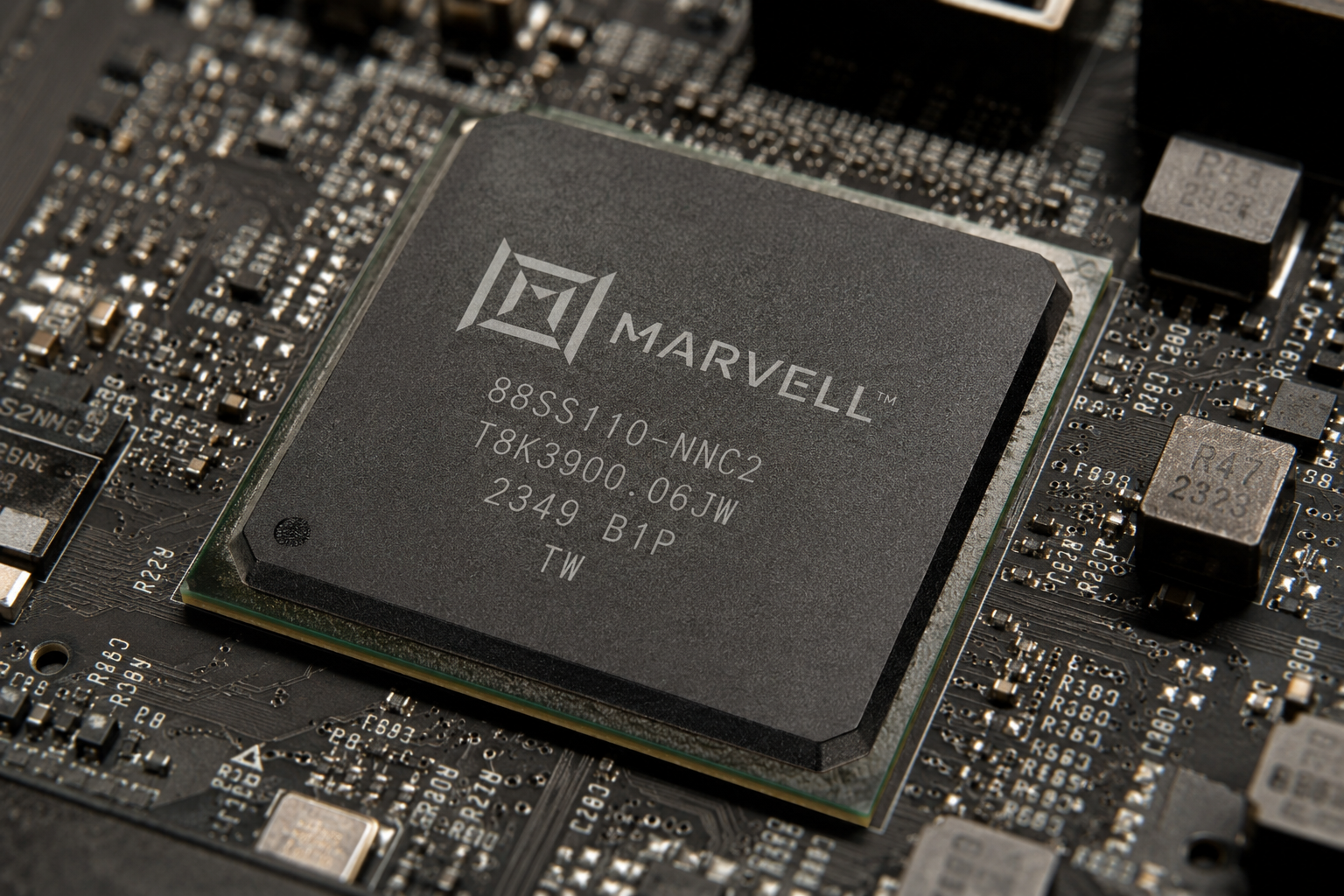
Marvell Technology could have more room to run after its sharp rally this year.
UBS became the latest brokerage to turn more bullish on the semiconductor company as artificial intelligence infrastructure spending accelerates demand for next-generation connectivity products.
The brokerage raised its price target on Marvell to $340 from $230, implying roughly 27.5% upside from Friday’s closing price.
UBS also lifted its target on Astera Labs to $400 from $205 while maintaining a Neutral rating, saying both companies stand to benefit from the rapid adoption of Compute Express Link (CXL), a technology increasingly viewed as essential for AI data centers.
Marvell’s MRVL share price was trading lower by about 1% on Monday though.
CXL demand expected to accelerate
UBS said CXL, a cache-coherent, low-latency, high-bandwidth interconnect built on PCIe, is becoming a critical technology as AI workloads require memory systems with significantly higher capacity and faster data movement.
“CXL is becoming a critical enabling technology. We believe MRVL has the leading market share in CXL products to date, but we do see ALAB becoming a larger player,” analyst Timothy Arcuri wrote in a note to clients on Monday.
The brokerage expects demand for CXL products to rise sharply as data centers evolve beyond conventional server architectures toward rack-wide and multi-rack memory fabrics connecting CPUs and XPUs.
UBS estimates the addressable market for CXL-related ASIC attachment products could grow to between $7 billion and $10 billion by 2030.
While Marvell currently leads the market, UBS expects competition to increase over time, with Astera Labs and Broadcom emerging as more significant players as adoption expands.
Higher revenue forecasts
Reflecting stronger demand expectations, UBS increased its revenue forecasts for Marvell over the next two years.
The brokerage expects CXL-related revenue to reach about $1 billion in 2027, driven primarily by XPU connectivity inside AI server racks, supported by growing demand for agentic AI running on CPUs.
It also projects Marvell’s CXL revenue will climb to roughly $2 billion in 2028.
Overall, UBS raised its 2027 revenue estimate to $16.8 billion from $16.5 billion and increased its 2028 forecast to $23.9 billion from $21.9 billion.
The brokerage also lifted earnings-per-share estimates to $6.23 for 2027 and $9.62 for 2028, compared with previous forecasts of $6.09 and $8.60.
Marvell, which now commands a market capitalization of roughly $233 billion, has posted revenue growth of 34% over the past 12 months and its shares have surged about 190% in 2026, significantly outperforming the broader S&P 500.
Networking seen as the next growth engine
Marvell has long been viewed as a beneficiary of the AI boom because of its custom application-specific integrated circuits (ASICs) designed for hyperscale cloud providers.
However, analysts increasingly believe the company’s networking business could prove even more valuable over the longer term.
Earlier this month, analysts led by John Vinh raised Marvell’s price target by 48% to $385 from $260 while reiterating an Overweight rating. The stock climbed 14% after that report.
Following an investor meeting with Marvell, KeyBanc said it had become increasingly optimistic about the company’s optical networking business, arguing that it could offer a more durable growth opportunity than custom AI chips.
The firm noted that increasingly powerful AI data centers require optical transceivers to move massive volumes of information by converting electrical signals into light.
Marvell supplies the digital signal processors used inside those transceivers.
“Networking represents the most significant and durable growth opportunity,” Vinh wrote, estimating the addressable market could reach approximately $30 billion by 2030.
He added that Marvell appears well positioned to capture a significant share of that opportunity as AI infrastructure spending continues to expand.
The post Marvell stock gets fresh boost as UBS raises price target on AI-driven CXL demand appeared first on Invezz