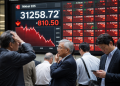

Samsung Electronics and SK Hynix fell sharply on Thursday, reversing Wednesday’s rebound and reinforcing concerns that South Korea’s artificial-intelligence trade is becoming a volatility machine.
SK Hynix plunged 6.95%, Samsung Electronics fell 2.44% and the Kospi lost 3.64%, sharply reversing Wednesday’s gains of about 6%, 3% and 4%.
The companies’ earnings outlook did not deteriorate overnight.
Global technology sentiment changed, illustrating how leverage, short positioning and crowded AI trades are turning ordinary shifts in mood into unusually large daily moves.
Wall Street weakness punctures a one-day memory rally
The immediate trigger came from the US, where the Nasdaq ended its winning streak after SpaceX and AMD fell following earnings.
AMD exceeded analysts’ forecasts but failed to satisfy expectations embedded in its valuation.
SpaceX beat revenue estimates, yet investors worried whether profitable Starlink operations could continue financing costly data-centre and artificial-intelligence expansion.
The weakness spread through Asian technology markets.
Kioxia plunged 9.61% in Tokyo, while chip-equipment maker Tokyo Electron lost 4.61%. Those declines suggest Thursday’s retreat was not caused by fresh trouble at Samsung or SK Hynix.
The reversal was striking because memory stocks had received a bullish signal only a day earlier.
SpaceX chief executive Elon Musk said “the limiting factor currently is memory,” arguing that supply growth lagged AI-related demand.
Leverage turns every mood change into a larger move
Korea’s semiconductor boom attracted leveraged retail investors and concentrated institutional positions.
When prices fell in July, margin calls and daily rebalancing by leveraged exchange-traded funds forced additional selling.
Charu Chanana, Saxo’s chief investment strategist, wrote that leverage amplifies losses and increases forced-sale risks during market stress.
She said powerful themes can become “crowded, expensive and vulnerable to corrections”.
Goldman Sachs estimates that assets in Korean leveraged ETFs have fallen from a June peak of $53 billion to $25 billion.
Retail margin-loan balances declined from $25 billion to $19 billion, suggesting substantial deleveraging has occurred without eliminating instability.
The mechanism also works in reverse.
Citi analyst David Chew told MarketWatch that Korean short positioning had become sufficiently one-sided for stabilising AI sentiment to trigger a short-covering rally.
That explains Wednesday’s surge and Thursday’s fall. Leveraged selling accelerates weakness, while short covering magnifies rebounds.
Neither movement necessarily signals next quarter’s demand for high-bandwidth memory.
Strong fundamentals are no longer enough to calm investors
Goldman Sachs remains bullish on the cycle. Its analysts wrote that memory demand was likely to be “stronger and last longer than previous ones,” supported by accelerating AI computing and shortages that could persist through 2030.
The bank nevertheless acknowledged concerns about Big Tech capital spending, financing risks and competition.
Investors are asking whether customers can maintain today’s expenditure and whether expanding production will eventually weaken pricing.
Samsung and SK Hynix have signalled plans to strengthen shareholder returns after reporting record quarterly profits.
Those commitments may support valuations, but Thursday’s decline showed that dividends and buybacks offer limited protection when global AI sentiment turns.
The post SK Hynix, Samsung stocks crash again: is Korea’s AI boom becoming volatility machine? appeared first on Invezz