
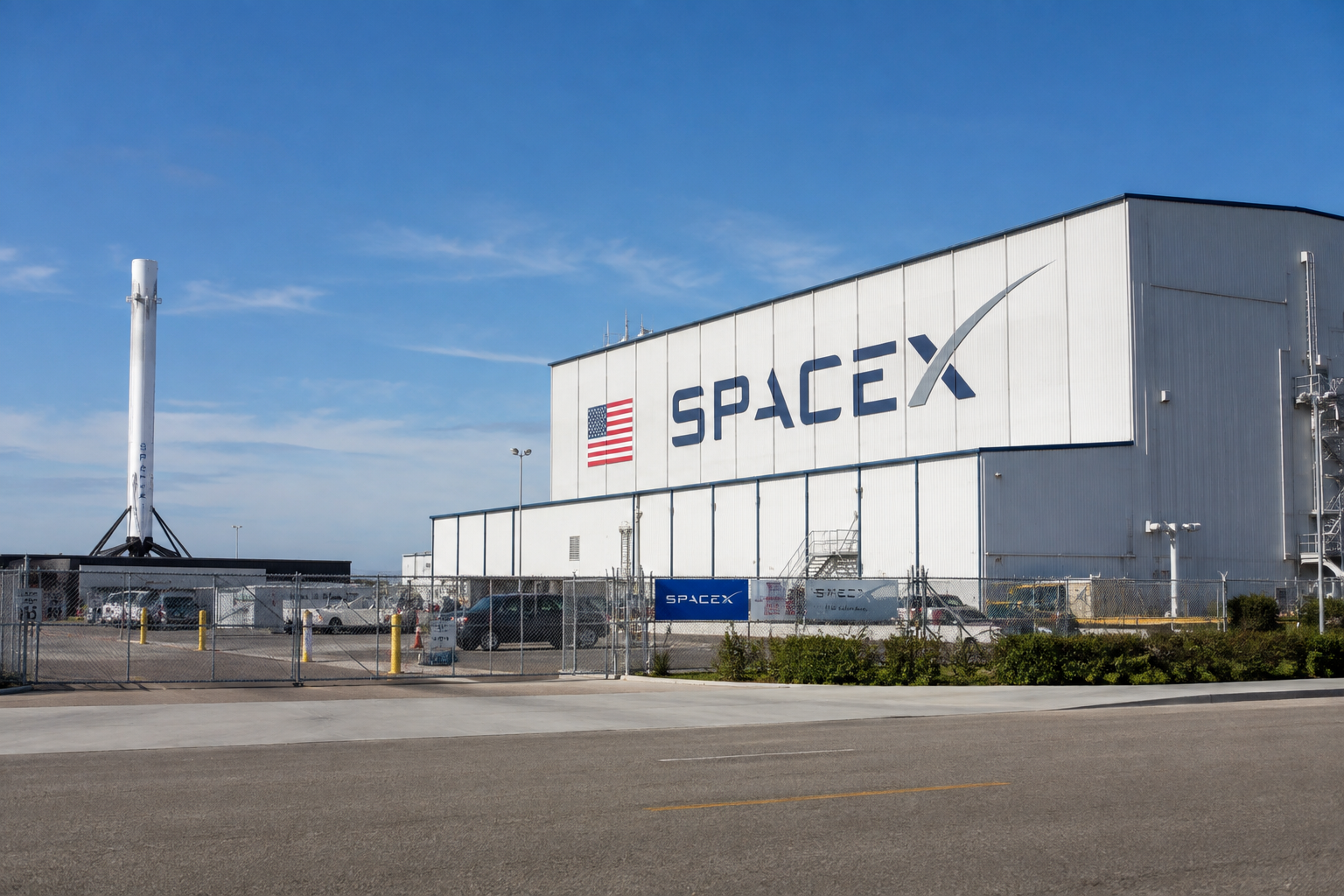
SpaceX SPCX stock rose 6% on Monday as investors responded to a series of disclosures showing significant institutional holdings in the company and a number of bullish analyst calls.
The stock also benefited from stronger sentiment across technology and artificial intelligence stocks following reports that Anthropic generated more than $11.5 billion in second-quarter revenue, a sharp increase from a year earlier.
The broader market was relatively subdued. The Nasdaq was up almost 0.1% on Monday, while the S&P 500 was down by roughly the same amount.
Nvidia reveals $21 billion SpaceX stake; Alphabet sees a 100-fold gain in stake value
Nvidia disclosed on Friday that its SpaceX investment was valued at about $21 billion at the end of the second quarter.
The chipmaker said in a filing with the US Securities and Exchange Commission that it held 122.8 million Class A shares in SpaceX.
At SpaceX’s Friday closing price of $140, Nvidia’s holding would be worth about $17.2 billion.
The position nevertheless remains substantial and reflects significant gains as compared to the reported $10 billion investment in the company through xAI in January, part of a $20 billion funding round.
FactSet data ranks Nvidia as the sixth-largest investor in SpaceX.
Alphabet has an even larger position.
The Google parent disclosed a SpaceX stake worth approximately $94 billion at the end of June, according to its latest filings.
That represents a more than 100-fold increase from Alphabet’s initial $900 million investment in Elon Musk’s rocket company in 2015.
A Reuters analysis of publicly available quarterly filings identified Alphabet as the largest single institutional holder of SpaceX following the company’s IPO.
Harvard and Norway fund join institutional investors
Harvard Management Co. has also disclosed a sizeable SpaceX investment.
The university endowment reported a $2.2 billion position in the company, representing a significant portion of its disclosed $4.3 billion US equity portfolio.
Norway’s $2.3 trillion sovereign wealth fund has also reported a SpaceX holding.
Norges Bank Investment Management disclosed a 0.05% stake valued at slightly more than $1.2 billion as of June 30.
The SpaceX investment is relatively small compared with the fund’s holdings in other major technology companies.
NBIM held a 1.3% stake in Nvidia worth about $61.8 billion and a 1.2% stake in Apple valued at around $52.7 billion at the end of June.
Other investors disclosing SpaceX positions include early backer Fidelity Investments, Saudi Arabia’s Public Investment Fund and Hancock Prospecting, controlled by Australian mining billionaire Gina Rinehart.
The disclosures have given investors a clearer view of the institutional support behind SpaceX as the company enters public markets.
Goldman Sachs sees space as a major economic sector
SpaceX has also received a broader boost from expectations for continued growth in the space industry.
In its recent report, “The Second Space Age”, Goldman Sachs described space as a potential “new pillar of the industrial economy” and said the sector was becoming increasingly important to economic activity on Earth.
The bank forecasts the global space economy will reach $1.8 trillion by 2035.
More than $55 billion was invested in the space ecosystem in 2025, while investment reached a record $36 billion in the first quarter of 2026, according to Goldman Sachs.
The growth is increasingly visible in public markets.
Aerospace companies have raised about $89 billion through IPOs since the start of 2025, which Goldman said reflected the growing institutionalisation of space as a distinct investment sector.
Firefly raised about $999 million through its IPO following its successful Blue Ghost lunar mission.
York Space Systems raised approximately $629 million to support its national-security business, while HawkEye 360 raised around $478 million to expand its space-based signals intelligence operations.
SpaceX raised more than $86 billion through its IPO, making it the largest public offering in history.
“These listings represent a broader institutionalization of space as a distinct sector within public equity markets,” it said.
“This maturation is crucial, as the next phase of space industrialization will require enormous sums of capital to build launch
capacity, satellite factories, lunar infrastructure, space-based data platforms, and resilient communications networks—upfront investments beyond what venture-backed companies can secure through private rounds alone. As space becomes
a core platform for defense, communications, data, and AI, the geopolitical value will only compound—accelerating
government demand and contracts in turn,” it said.
UBS sees further upside for SpaceX
UBS has reiterated a Buy rating and a $210 price target on SpaceX.
Analyst John Hodulik pointed to SpaceX’s position in cloud services and frontier artificial intelligence models as important parts of the company’s growth story.
UBS expects growth to accelerate as SpaceX reaches critical mass with its V3 fixed broadband satellite network, potentially sometime next year.
The company generated $23 billion in revenue over the last 12 months, while analysts are forecasting 138% revenue growth this fiscal year.
UBS also highlighted SpaceX’s plans to deploy small radios in its next-generation Starlink terminals.
The technology could help provide coverage in areas that the existing V2 mobile low-Earth-orbit constellation cannot easily reach, including dense locations and the interiors of office buildings.
The strategy will depend partly on access to low-band spectrum and the ability to deploy the devices at sufficient density.
UBS expects US Starlink subscribers to increase from about 3 million currently to 6 million by the end of 2027 and 20 million by the end of 2031.
Bearish analysts point to revenue risks
Despite the bullish calls, Phillip Securities has maintained a Sell rating and a $75 price target on SpaceX.
The firm acknowledged the company’s strong second-quarter growth but questioned whether its revenue expansion can be sustained.
SpaceX reported second-quarter 2026 revenue of $7.8 billion, up 92% from a year earlier. First-half revenue reached 43% of Phillip Securities’ full-year forecast.
AI revenue surged 247% year over year, including $1.6 billion from the initial ramp-up of cloud services agreements signed during the quarter.
However, Phillip Securities highlighted increasing customer concentration. One AI customer accounted for 19.5% of SpaceX’s second-quarter revenue, up from less than 10% a year earlier.
The company also recorded an operating loss of $542 million, while capital expenditure was 2.4 times revenue.
The post Why is SpaceX stock rallying today? appeared first on Invezz